
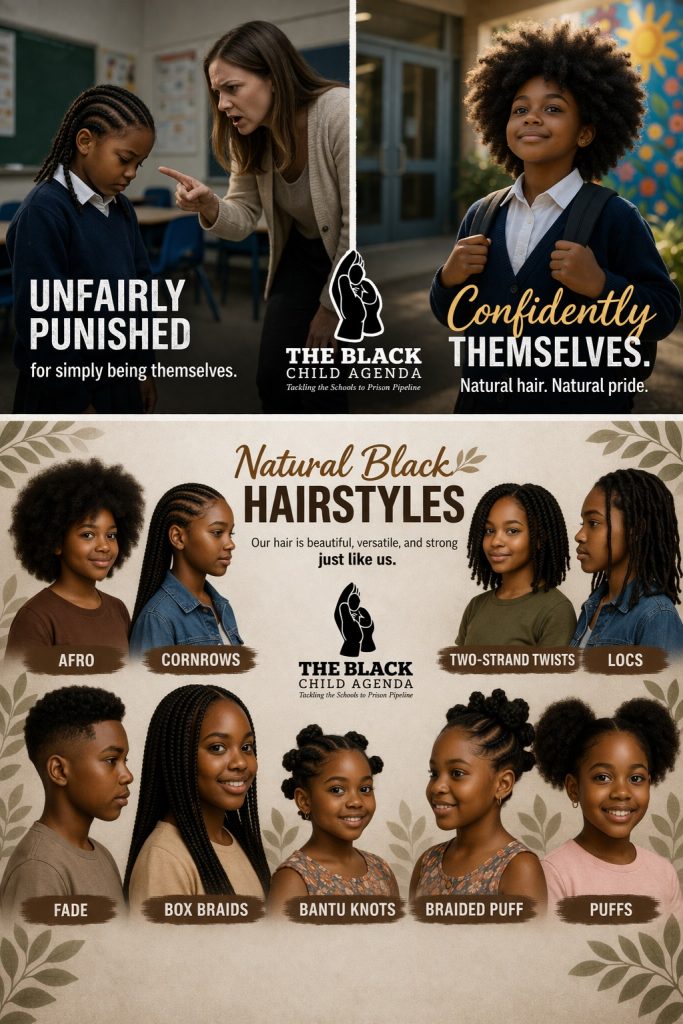
Why Black Children Are Still Being Punished for Their Hair
Introduction
“Your hair is distracting.”
“Braids are not part of our uniform policy.”
“Can you tie it back? It’s too big.”
These are not comments from the playground. They are formal disciplinary decisions made by UK schools. And they are aimed almost exclusively at Black children.
Hair—Afros, cornrows, twists, locs, braids—is not just a style. It is an expression of culture, identity, and heritage. Yet for too many Black children in British schools, their natural hair becomes a reason to be excluded, isolated, and shamed.
The Reality in UK Schools
Across the country, Black children are being removed from lessons, placed in isolation, or even permanently excluded because of their hair. In some cases, schools have sent children home for wearing their natural hair “too long” or for having braids that “violate” uniform policies that were written without Black children in mind.
In 2020, the Equality and Human Rights Commission published guidance making clear that banning hairstyles associated with a particular race is likely to be unlawful indirect discrimination under the Equality Act 2010. Yet years later, the stories keep coming.
Ruby Williams: A Landmark Case
One of the most well‑known cases is that of Ruby Williams, a Black British schoolgirl who was repeatedly sent home from school in East London because of her Afro hair. Her family took legal action, and in 2020, she received a settlement and an apology. The school also revised its uniform policy.
Ruby’s case was not an anomaly. It was a public example of a hidden epidemic. For every Ruby whose case makes the news, there are hundreds of Black children quietly being disciplined for the very features that make them who they are.
Why This Is Not “Just About Hair”
When a child is told their hair is “unacceptable,” the message goes far deeper:
- Shame: A child learns that their natural self is wrong.
- Disengagement: School becomes a place of judgment, not belonging.
- Disproportionate discipline: Hair discrimination contributes to the higher exclusion rates for Black children, especially Black girls.
- Adultification: Black girls are often described as “aggressive” when they challenge hair policies, while Black boys are treated as threatening for wearing styles like locs or braids.
This is not a trivial matter. It is a safeguarding issue. A child’s sense of identity and self‑worth is shaped by how their school treats them. When schools police Black hair, they send a clear signal: you do not belong here.
What the Law Says
Under the Equality Act 2010, schools have a duty to avoid indirect discrimination. If a uniform policy applies to all pupils but disproportionately disadvantages pupils of a particular race, the school must justify the policy as a “proportionate means of achieving a legitimate aim.” In most cases, banning Afro hairstyles or braids cannot be justified.
The Equality and Human Rights Commission has explicitly stated that “a policy which prohibits hairstyles associated with a particular race… is likely to be unlawful indirect discrimination.”
Yet enforcement remains weak. Too many schools still rely on outdated policies, and too many parents do not know their rights.
What Needs to Change
- Review uniform policies: Every school should audit its uniform and appearance policy to ensure it does not disproportionately affect Black children. If it does, change it.
- Train school leaders: Governors, headteachers, and staff must understand their legal duties under the Equality Act and the impact of hair discrimination on children’s wellbeing.
- Support parents: Parents should know they can challenge hair‑related disciplinary decisions using the school’s complaints policy and, if necessary, by raising a discrimination claim.
- Celebrate Black hair: Schools should actively celebrate Black hair through curriculum, assemblies, and inclusive language.
A Call to Action
This week, we ask you:
- If you are a parent, check your child’s school uniform policy. Does it include any language about hair that could be used against Black children? If so, ask for it to be reviewed.
- If you work in a school, is your policy inclusive? Have you considered how your approach to hair affects Black pupils’ sense of belonging?
- If you are a policymaker, what steps are you taking to ensure that every school is complying with equality law on this issue?
No child should have to choose between their education and their identity. Hair is not a distraction. It is heritage. It is pride. It is a crown.
Download our Advocacy Toolkit for guidance on how to challenge hair discrimination in schools.
Share this post to raise awareness.
Join us in demanding that every school becomes a place where Black children can wear their crown without fear.
#HairLove #NaturalHair #BlackGirlMagic #EducationEquality #TheBlackChildAgenda #StopHairDiscrimination #Afro #Braids #EqualityAct2010 #BlackChildren