
How Our Education System Is Criminalising Black Children
Introduction
There is a well‑trodden path in this country. It starts with a child who struggles to read, who fidgets in class, who arrives at school with a hairstyle that the uniform policy doesn’t “allow.” That child is labelled “difficult.” They are excluded, first for a day, then for a week, then permanently. They fall behind. They become known to the police. And eventually, they find themselves in the youth justice system.
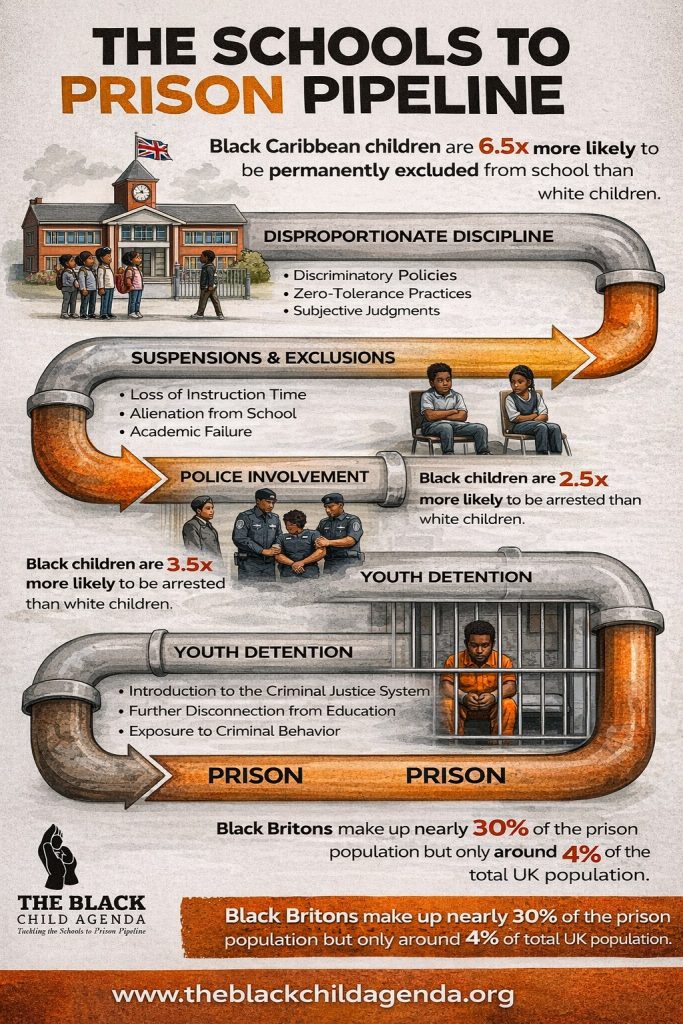
This is not a natural progression. It is a pipeline. And it is one that Black children are funnelled into at alarming rates.
We call it the Schools to Prison Pipeline—and it is a national scandal.
What Is the Schools to Prison Pipeline?
The term describes the policies and practices that push children out of education and into the criminal justice system. It is not a single decision but a series of failures: a school that punishes rather than supports, a system that criminalises behaviour rather than understanding it, and a society that views Black children as threats rather than children.
The pipeline is fed by:
- Exclusion policies that disproportionately target Black pupils
- Undiagnosed SEN that leads to frustration and punishment instead of support
- Adultification that perceives Black children as older and less innocent
- Hair discrimination that alienates children from their school community
- Police presence in schools that turns minor incidents into criminal records
Each of these is a gate. And for too many Black children, the gates only open one way—out of the classroom and into the justice system.
The Data We Cannot Ignore
- Black Caribbean pupils are over three times more likely to be permanently excluded than their white peers.
- Children who are permanently excluded are over twice as likely to become involved in the youth justice system within a year.
- Over 70% of young people in custody have speech, language, or communication needs—most undiagnosed during their school years.
- Black children are over‑represented at every stage of the youth justice system, from stop and search to custody.
These are not coincidences. They are the results of systemic bias, institutional failure, and a refusal to see Black children for who they are: children.
How the Pipeline Operates in Practice
Stage 1: School as a Hostile Environment
A Black child with undiagnosed ADHD is repeatedly told off for “not listening.” Their frustration grows. The school, instead of assessing their needs, issues a fixed‑term exclusion. They return to a classroom where they are now seen as a “problem.”
Stage 2: Disengagement and Surveillance
Falling behind academically, the child begins to truant. On the streets, they are stopped by police. Their name now appears on local systems as “known to the authorities.” The school sees this as confirmation of their earlier judgment.
Stage 3: The Final Push
Another incident—a playground argument, a raised voice—results in permanent exclusion. The child is sent to a pupil referral unit (PRU) where support is minimal. Without a stable school environment, they become more vulnerable to exploitation and further criminalisation.
Stage 4: Criminalisation
A minor offence that could have been dealt with by a school becomes a police matter. The child enters the youth justice system. Their education is now an afterthought.
Why We Must Intervene
Every stage of this pipeline is preventable. When a child is excluded without an assessment of their SEN, that is a failure of the education system. When a child is criminalised for behaviour rooted in unmet needs, that is a failure of the justice system. When a child is treated as a threat because of their race, that is a failure of society.
We cannot accept a system that writes off Black children before they reach adulthood.
What We Are Doing
At The Black Child Agenda, we are working to break the pipeline through:
- Legal advocacy: Our Advocacy Toolkit helps parents challenge exclusions, request EHC assessments, and understand their child’s rights.
- Training: We work with schools and local authorities to recognise and dismantle racial bias in discipline and SEN identification.
- Community education: We raise awareness of the pipeline so parents and professionals can spot the warning signs early.
- Policy influence: We campaign for mandatory data collection on exclusions, SEN, and criminalisation by ethnicity, so the scale of the problem can no longer be ignored.
What You Can Do
- If you are a parent: Know your rights. If your child is at risk of exclusion, contact us or your local SENDIASS service immediately. Use our templates to demand an EHC assessment.
- If you work in education: Review your exclusion data by ethnicity. Are Black children being disproportionately excluded? If so, ask why—and act.
- If you work in youth justice: Ask every young person you encounter whether their SEN was ever assessed. If not, that is a systemic failure that needs addressing.
- If you are a professional in any sector: Share this post. Talk about the pipeline. Make it visible.
A Final Word
The Schools to Prison Pipeline is not inevitable. It is a construct—one built by policy, bias, and neglect. And what has been built can be dismantled.
Every child deserves a future, not a pathway to prison. Every Black child deserves to be seen, supported, and given the chance to thrive. Together, we can break the pipeline.
Learn more about our work on this issue at [link to your existing page].
Download our Advocacy Toolkit for practical resources to protect your child’s education.
Share this post to demand that our schools educate, not criminalise.
#SchoolsToPrisonPipeline #BlackYouth #EducationJustice #SystemicChange #Advocacy #TheBlackChildAgenda #EndRacism #Exclusions #EHCP #YouthJustice #SEN