
The Stop and Search Scandal No One Should Ignore
Introduction
In the UK, around 74% of stop and searches involving children result in no further action. No weapon found. No drugs seized. No crime discovered.
Yet Black boys continue to be stopped, searched, and treated as suspects—often before they reach secondary school.
This isn’t about safety. This is about perception. And perception is shaping outcomes.
The Data That Should Stop Us
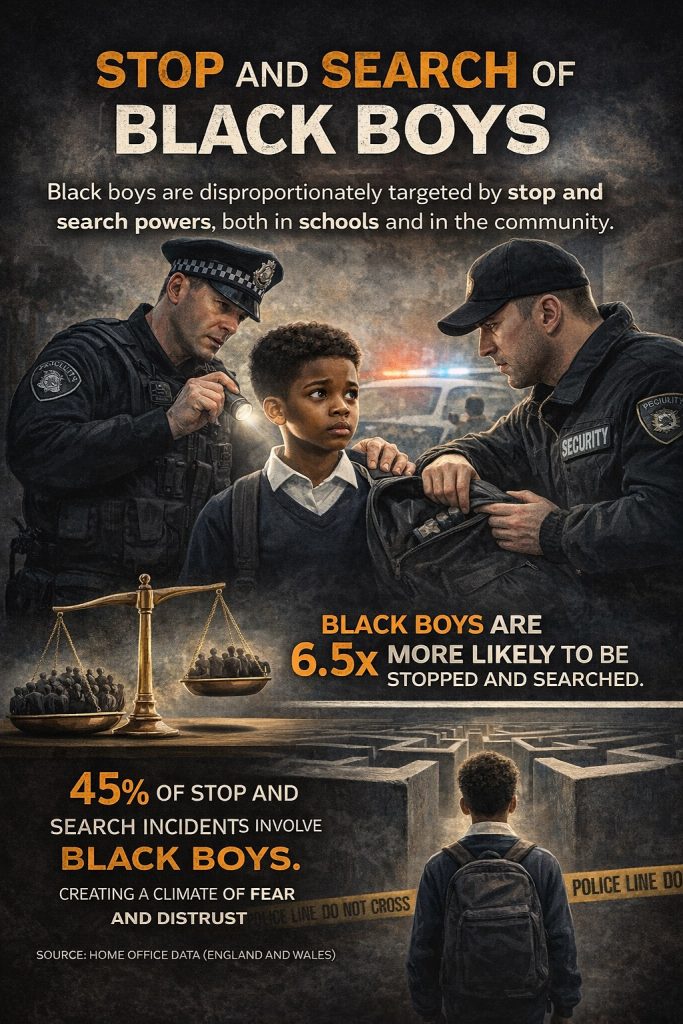
Official Home Office figures show year after year that Black children are disproportionately targeted by stop and search powers. In some police forces, Black children are over six times more likely to be stopped than their white peers.
When a child is stopped, they are not just inconvenienced. They are being told, often in public and in front of peers, that they are a threat. That their very presence is suspicious.
The impact doesn’t end when the search ends.
A Schoolgate Reality
These encounters often happen within or immediately outside school gates. Children in uniform, on their way to or from lessons, are stopped. The message is clear: even in the place meant for learning, you are viewed with suspicion.
What does that do to a child’s sense of belonging? To their trust in authority? To their belief that education will lead to a fair future?
We already know that Black children are more likely to be excluded, more likely to have their needs misunderstood, and more likely to be criminalised for behaviours that in other children are treated as “youthful” or “needing support.” Stop and search adds another layer: state‑sanctioned suspicion, imprinted on a child.
Why It Matters for All of Us
Some argue that stop and search is a necessary tool. But when 74% of searches on children yield nothing, it is not effective—it is harassment dressed up as crime prevention.
The real cost is the erosion of trust. Trust in police. Trust in institutions. Trust that society sees Black children as children, not as future offenders.
And when trust breaks, young people disengage. They stop reporting crime. They stop feeling safe. And the cycle of criminalisation continues.
What Must Change
- Transparency: Every police force must publish stop and search data by age, ethnicity, and outcome—and be held accountable where disproportionality persists.
- Accountability: Where a child is stopped and no further action is taken, the incident should be reviewed for potential bias.
- Education: Schools and police must work together to ensure that law enforcement does not become a routine part of a Black child’s school day.
- Community voice: Parents and community organisations must have a seat at the table when local policing strategies are designed.
A Call to Action
This week, we ask you:
- If you work in education, are you aware of how many of your Black pupils are being stopped on their way to school?
- If you work in policing, are you examining the data on child stops—and questioning what the 74% “no further action” figure really means?
- If you are a parent, do you know your child’s rights during a stop and search? (Our Advocacy Toolkit includes a guide.)
We cannot accept a system that treats Black childhood as suspicious. We cannot look away while children are criminalised before they have even had the chance to learn.
Download our Advocacy Toolkit for resources on your child’s rights during police encounters.
Share this post to demand change.
Join us in calling for a justice system that sees children as children—not as suspects.
#StopAndSearch #BlackBoys #RacialProfiling #YouthJustice #TheBlackChildAgenda #EndDiscrimination #UKPolicing #ChildRights #EducationNotCriminalisation