
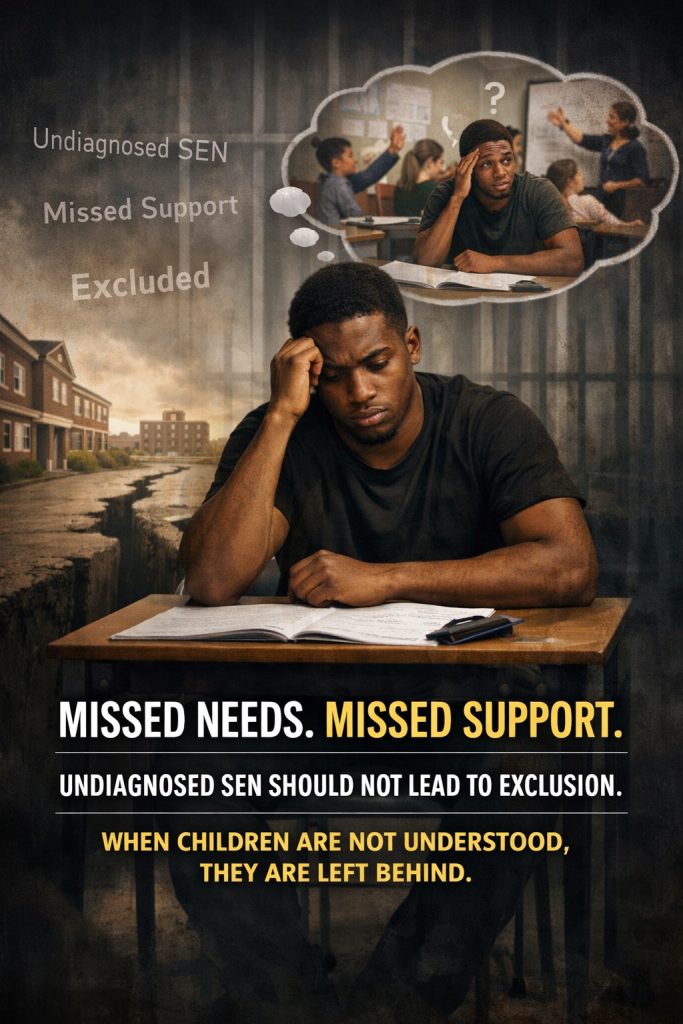
How Educational Neglect Criminalises Black Children
Introduction
When a child struggles to read, cannot sit still, or finds social cues impossible to decode, school should be the place where they are supported, understood, and given the tools to thrive. Instead, for too many Black children, undiagnosed Special Educational Needs (SEN) become a fast track to exclusion, criminalisation, and ultimately prison.
The link between undiagnosed SEN and youth justice is not a coincidence. It is a system failure—and it is one that disproportionately affects Black families.
The Hidden Statistic
Across the UK, research consistently shows that a staggering proportion of young people in the youth justice system have undiagnosed or unsupported SEN. Figures from the Ministry of Justice and the Youth Justice Board suggest that over 70% of young offenders have some form of speech, language, communication, or learning need—often unidentified during their school years.
For Black children, the numbers are even more stark. Black Caribbean pupils are already over three times more likely to be permanently excluded than their white peers. When SEN is present, that risk multiplies. Yet Black children are also less likely to receive an Education, Health and Care Plan (EHCP) or early support for needs like autism, ADHD, or speech disorders. Instead of being seen as children requiring help, they are often perceived as “challenging” or “threatening.”
From Classroom to Courtroom
Let’s follow the pattern:
- A Black child with undiagnosed ADHD struggles to remain seated, blurts out answers, and is labelled “disruptive.”
- Without a diagnosis, the school focuses on punishment rather than support. Fixed-term exclusions begin to pile up.
- The child falls behind academically, loses connection with teachers, and begins to disengage.
- Frustration at school spills over; the child is now “known to the local authority” for behaviour.
- Eventually, an incident that should have been managed with proper SEN support results in a permanent exclusion, and soon after, contact with the youth justice system.
This is not a hypothetical. This is the lived experience of many Black families we speak to. Educational neglect—the failure to identify, assess, and support SEN—has become a direct driver of youth incarceration.
Why Does This Happen?
- Inconsistent identification: Schools vary widely in how they spot SEN. Black children are often under‑identified for autism and ADHD, and over‑identified for behavioural “difficulties.”
- Cultural bias: Implicit bias means that the same behaviours are seen as “needs” in white children but “non‑compliance” in Black children.
- Exclusion before support: Many Black children are excluded from school before any formal SEN assessment has taken place.
- The EHCP gap: Black children are significantly less likely to have an EHCP than white children with similar needs, leaving them without legal protection or the support they need.
What Needs to Change
- Early identification in primary school: Every school must have a clear, racially aware pathway for identifying SEN in Black children before behaviour escalates.
- Mandatory ethnicity data: Local authorities and the youth justice system must publish data on SEN identification and outcomes by ethnicity, so we can see where the failures are most acute.
- Legal accountability: If a child ends up in the justice system and it emerges that their SEN was never assessed, that should trigger an independent review of the support they should have received.
- Parental advocacy: Parents need accessible, free support to challenge decisions and request EHC assessments. Our Advocacy Toolkit is designed to help families do exactly that.
A Call to Action
This week, we ask you to consider:
- If you work in education, are you confident that SEN identification in your school is free from racial bias?
- If you work in youth justice, do you know whether the young people you encounter have undiagnosed needs that were never addressed?
- If you are a parent, have you been told your child is “naughty” without an assessment? You have the right to ask for one.
We cannot keep watching the same cycle: school failure, exclusion, prison. The SEN to prison pipeline is real. But it is also preventable.
Download our Advocacy Toolkit for templates to request an EHCP assessment, challenge exclusions, and advocate for your child.
Share this post to raise awareness.
Join us in demanding that every child—especially Black children with SEN—receives the support they deserve before it is too late.
#SEN #UndiagnosedSEN #YouthJustice #EducationMatters #BlackChildren #TheBlackChildAgenda #SystemicFailure #PrisonReformUK #EHCP #InclusiveEducation